Rethinking Surgical Smoke:
A Smoke-Type-Aware Laparoscopic Video Desmoking Method and Dataset

Accepted at AAAI 2026

📢 Our dataset has been fully released! Visit the dataset website for downloads and details.

Qifan Liang1,2,5, Junlin Li3, Zhen Han*1,2, Xihao Wang1,2, Zhongyuan Wang1,2, Bin Mei4

1 National Engineering Research Center for Multimedia Software, School of Computer Science, Wuhan University, China

2 Hubei Key Laboratory of Multimedia and Network Communication Engineering, School of Computer Science, Wuhan University, China

3 School of Cyber Science and Engineering, Wuhan University, China

4 Zhongnan Hospital, Wuhan University, China

5 National University of Singapore, Singapore

* Corresponding author

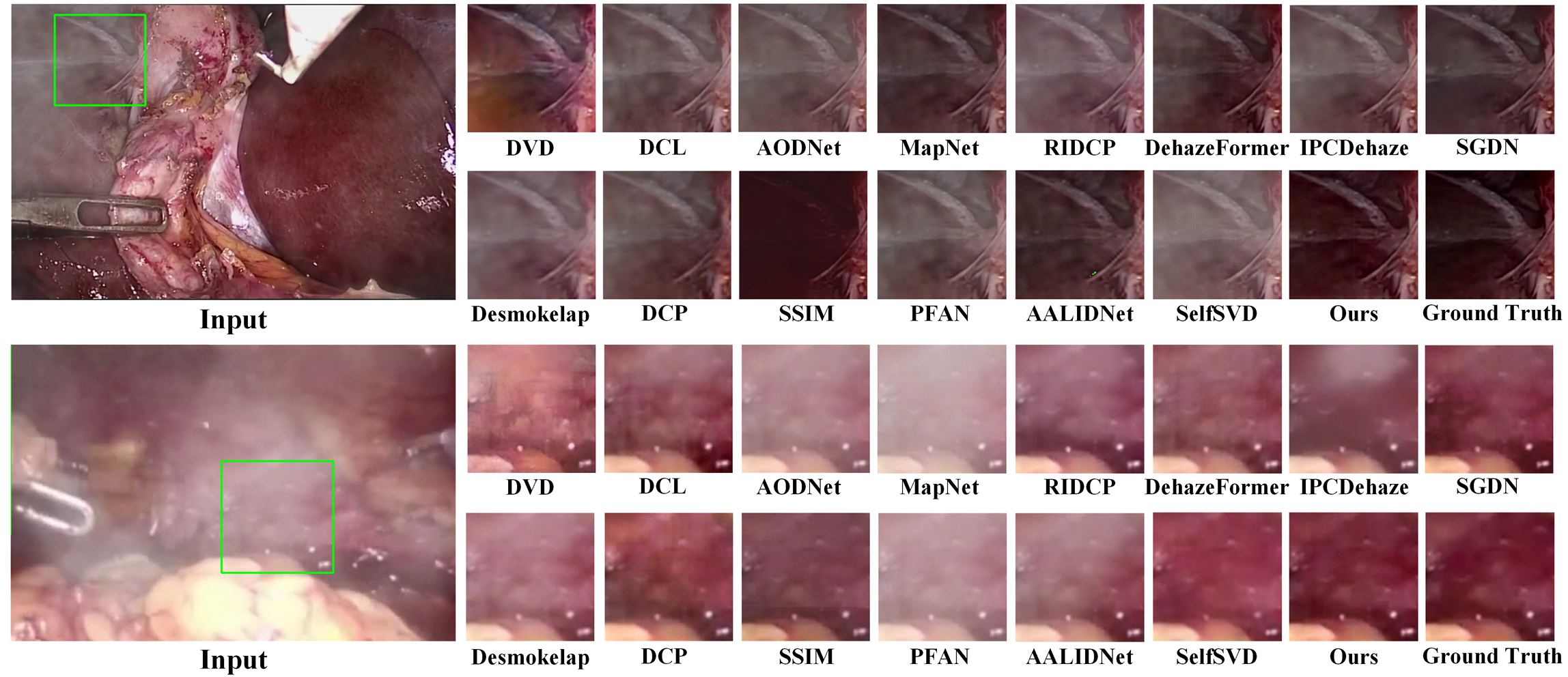
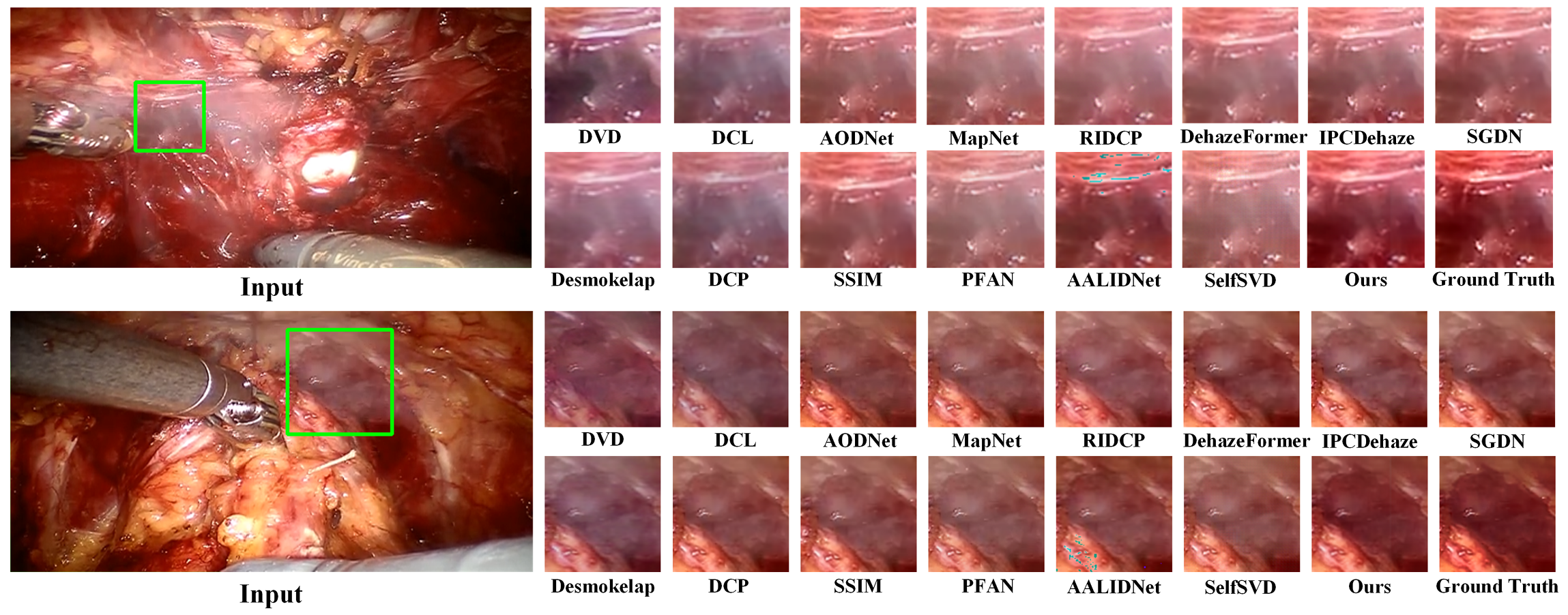
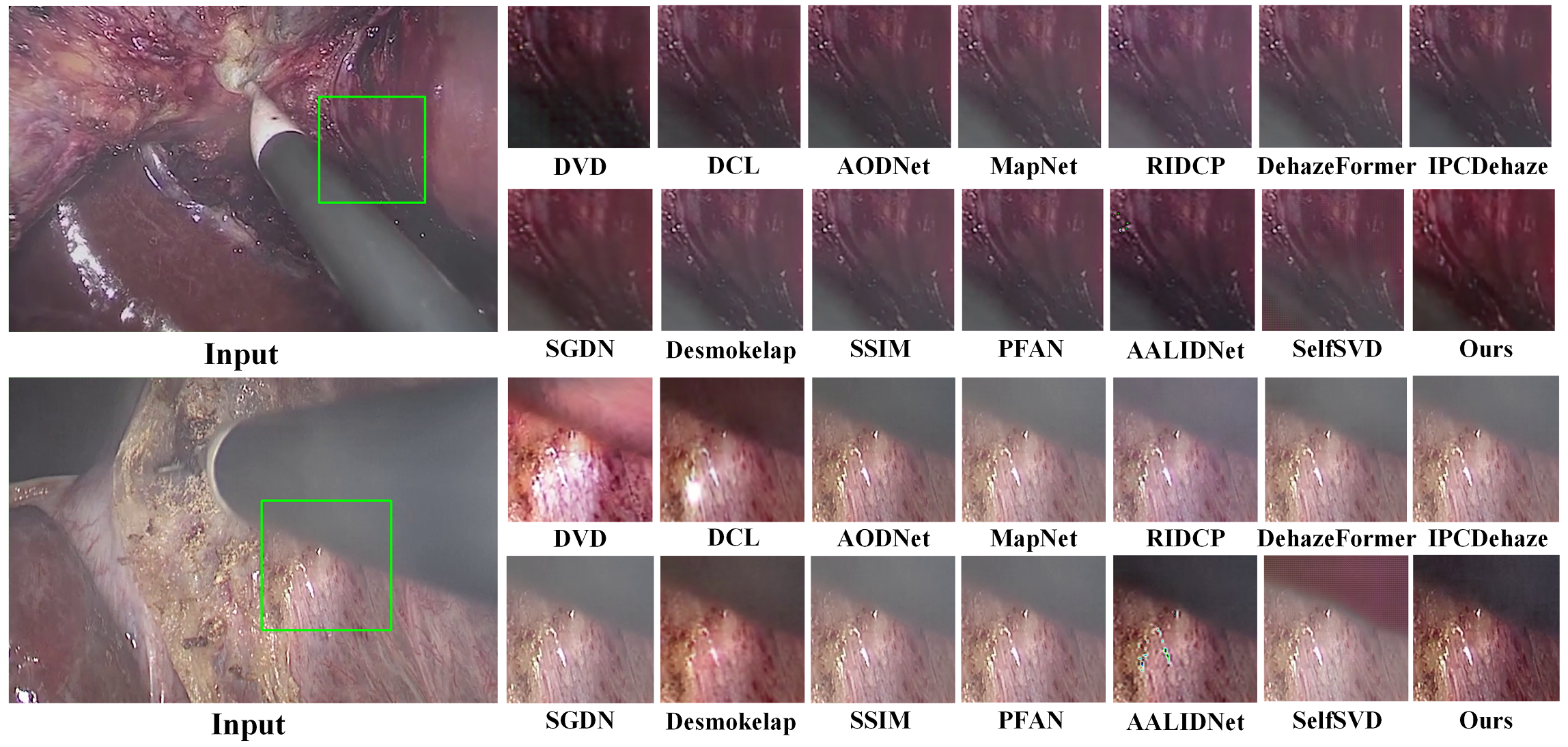
Visual Comparison: Smoky Video Input vs. Our Desmoking Output

Abstract

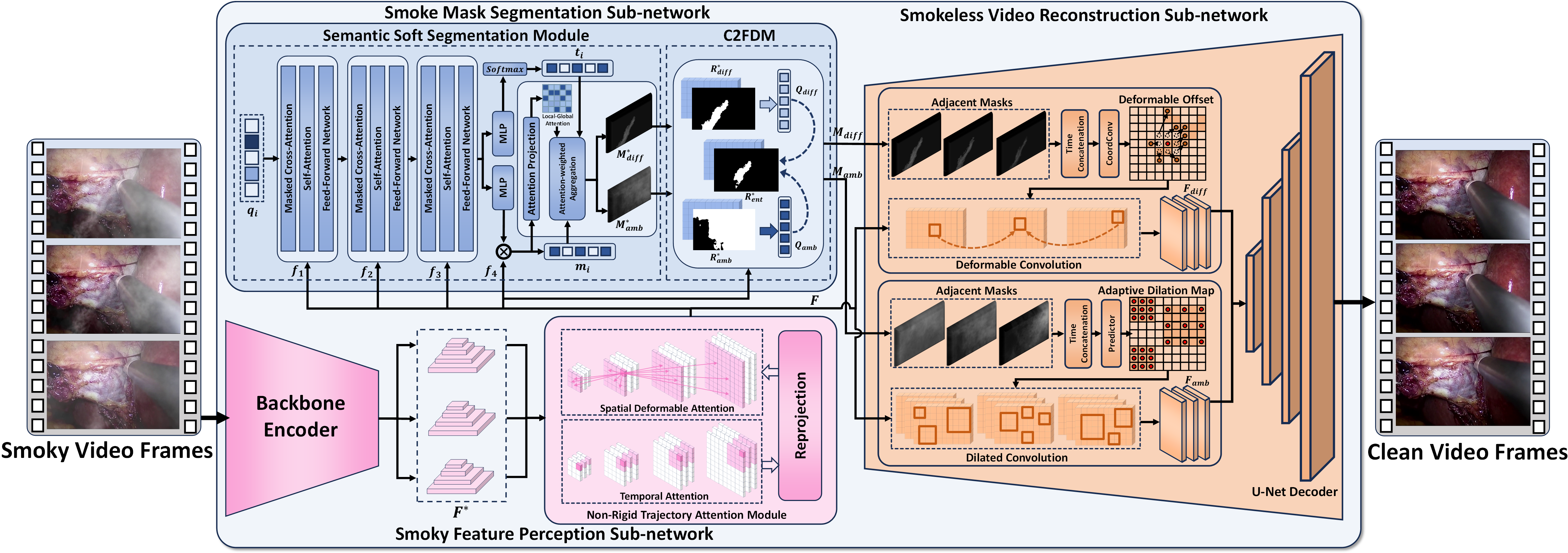
Electrocautery or lasers will inevitably generate surgical smoke, which hinders the visual guidance of laparoscopic videos for surgical procedures. The surgical smoke can be classified into different types based on its motion patterns, leading to distinctive spatio-temporal characteristics across smoky laparoscopic videos. However, existing desmoking methods fail to account for such smoke-type-specific distinctions. Therefore, we propose the first Smoke-Type-Aware Laparoscopic Video Desmoking Network (STANet) by introducing two smoke types: Diffusion Smoke and Ambient Smoke. Specifically, a smoke mask segmentation sub-network is designed to jointly conduct smoke mask and smoke type predictions based on the attention-weighted mask aggregation, while a smokeless video reconstruction sub-network is proposed to perform specially desmoking on smoky features guided by two types of smoke mask. To address the entanglement challenges of two smoke types, we further embed a coarse-to-fine disentanglement module into the mask segmentation sub-network, which yields more accurate disentangled masks through the smoke-type-aware cross attention between non-entangled and entangled regions. In addition, we also construct the first large-scale synthetic video desmoking dataset with smoke type annotations. Extensive experiments demonstrate that our method not only outperforms state-of-the-art approaches in quality evaluations, but also exhibits superior generalization across multiple downstream surgical tasks.
Banner Image

The overall framework of our STANet. The pink, blue and orange regions respectively denote the Smoky Feature Perception Sub-network, the Smoke Mask Segmentation Sub-network and the Smokeless Video Reconstruction Sub-network.

Datasets

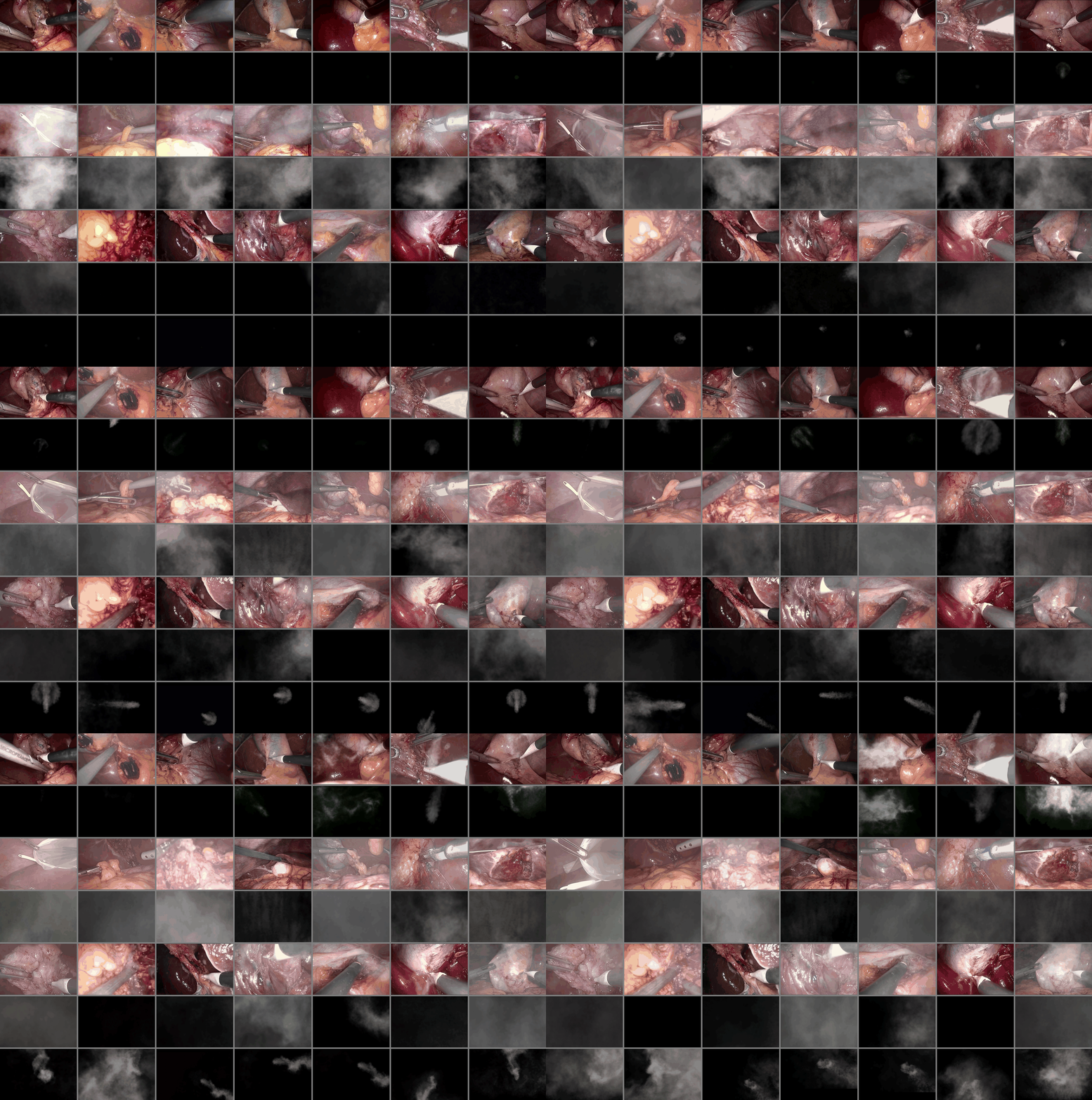
Due to the lack of smoke type annotations in existing desmoking datasets, we construct a large-scale Smoke-Type-Specific Video Desmoking (STSVD) dataset, including 120 videos (100 frames each, 720×1080 resolution) with semantic labels for Diffusion Smoke, Ambient Smoke, and their entanglement across 28 types of surgical scenarios.

Dataset Pipeline and Statistics

Dataset Overview: From top to bottom are Diffusion Smoke, Ambient Smoke, and their entanglement, along with their corresponding GT smoke masks.

Experiment: Visual Comparisons

Ethics Statement

All data used in this study are derived from publicly available laparoscopic surgery datasets that are released with appropriate usage permissions. No personally identifiable information or patient-sensitive data is involved.

BibTeX


% The official BibTeX entry will be provided upon AAAI-26 publication.
% Please check back later for the updated citation.
% The following is arxiv version:
@misc{liang2025rethinkingsurgicalsmokesmoketypeaware,
      title={Rethinking Surgical Smoke: A Smoke-Type-Aware Laparoscopic Video Desmoking Method and Dataset}, 
      author={Qifan Liang and Junlin Li and Zhen Han and Xihao Wang and Zhongyuan Wang and Bin Mei},
      year={2025},
      eprint={2512.02780},
      archivePrefix={arXiv},
      primaryClass={cs.CV},
      url={https://arxiv.org/abs/2512.02780}, 
}